DWS: Why Detectable Warning Surfaces Exist
Many of us pass over truncated domes every day without stopping to consider why they are there. To some, they are simply sidewalk bumps, perhaps even decorative. Others recognize that they have something to do with vision impairments and call them “sidewalk braille,” without knowing what message they convey. Together, the domes form a detectable warning surface (DWS): a tactile warning for pedestrians who are blind or have low vision.
At a street crossing, a sighted pedestrian can see the sidewalk ending, the traffic beyond it, and often the crosswalk markings or signal. A pedestrian who is blind cannot rely on those visual cues. A raised curb can provide a physical clue that the sidewalk has ended, but a curb ramp or blended transition removes that edge. At locations where a DWS is called for, its truncated domes provide a warning detectable by cane or underfoot before the pedestrian enters the street. A similar warning concept is used at certain transit boarding edges. The domes warn of the approaching boundary; they do not tell someone which direction to cross.
That distinction matters. A row of truncated domes is not a directional path. Nor does placing domes somewhere on a project automatically make the crossing accessible. The warning must make sense in relation to the pedestrian’s approach and the condition beyond it. A perfectly formed product can still communicate the wrong message if it is placed at the wrong location.
A warning in the wrong place can send the wrong message
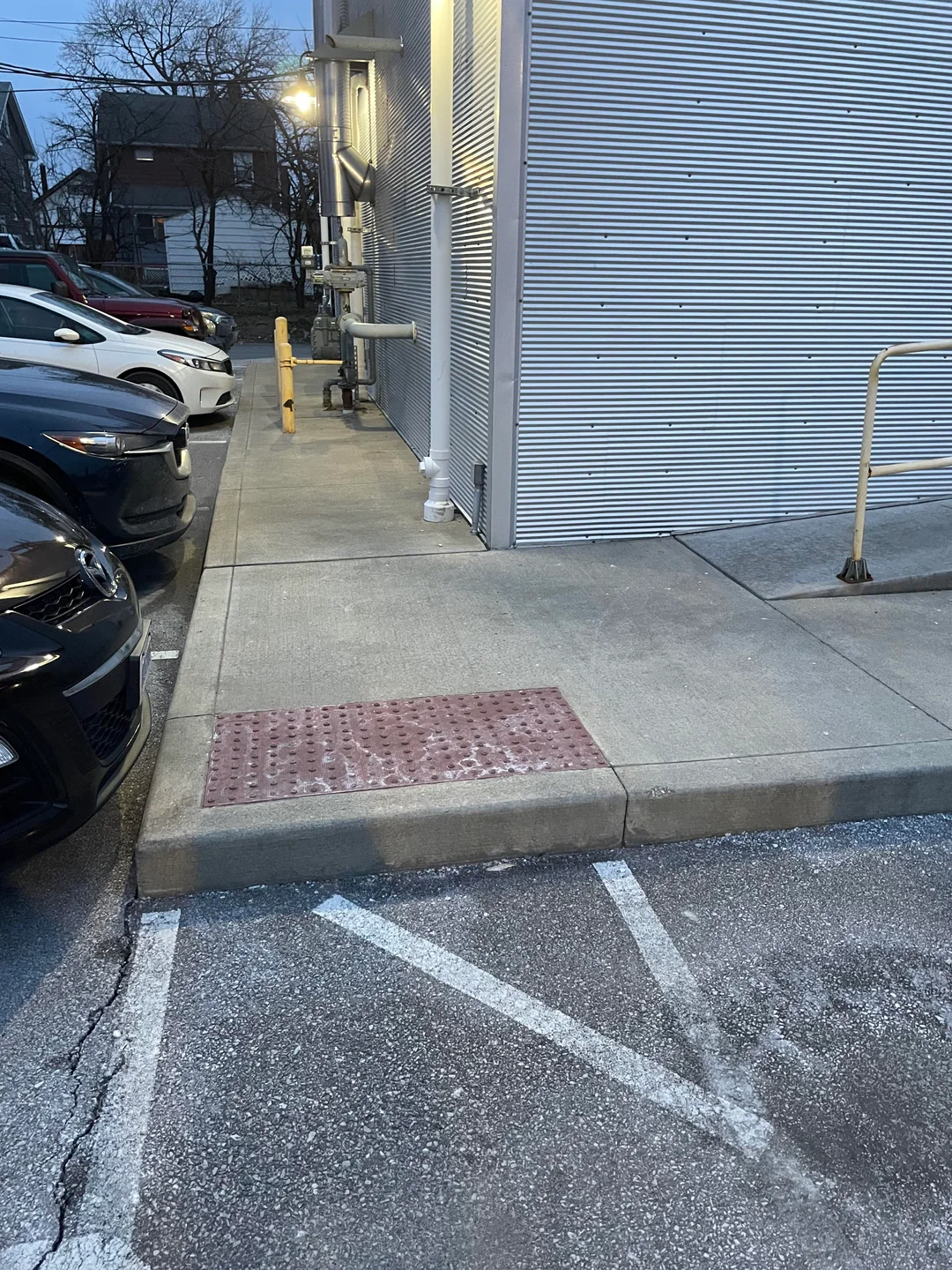
Field photo: a truncated-dome panel sits beside a striped parking area at a raised curb. The photograph alone does not establish the site’s governing requirements or the intended route.
Consider what that panel tells someone who detects it by cane or underfoot. Truncated domes signal that the traveler is approaching a location that calls for a detectable warning—often a transition where the usual curb cue is absent. Here the domes lead toward a visible vertical curb, with parking-area pavement below. The tactile warning may suggest a crossing or flush transition where the photo shows a drop instead. A traveler who follows that message could move toward the curb and encounter a step down, or search for a crossing that is not apparent at this location.
The panel also stops partway across the sidewalk edge. Someone traveling along the same edge might encounter a warning in one position and an ordinary curb in another, without a clear reason for the change. The issue is not whether the domes can be felt; it is whether the warning consistently matches the route and the condition beyond it.
The U.S. Access Board’s ADA §705 describes the detectable-warning pattern. The final Public Right-of-Way Accessibility Guidelines address applications in public rights-of-way. But determining whether a particular project needs DWS—and precisely how it should be laid out—requires identifying the facility type, controlling requirements, project details, and actual field geometry. The Access Board cautions that the federal ADA Standards do not impose the same curb-ramp detectable-warning requirement on every site outside transportation facilities. Access Board curb-ramp guide.
For project teams, the useful starting question is not “Which dome panel should we buy?” It is: What condition needs to be communicated here, and where will a pedestrian encounter it? The answer helps the team determine where the warning belongs and how it should be laid out. They can then select a product and installation method suited to the site and its applicable requirements.
AccessField helps teams connect the intended pedestrian message to a buildable, project-specific TWSI approach by examining the applicable requirements, project documents, and site conditions.
This article is educational. It is not a determination that a DWS is required at any particular location or a substitute for the project design professional or authority having jurisdiction.