TDI: When a Walking Surface Is Meant to Guide
Most pedestrian environments contain more wayfinding information than we consciously notice. A building edge, curb, fence, or predictable path can help a traveler maintain direction. In a large open plaza, unusual crossing, or complex transit setting, those cues may disappear or point the wrong way.
A tactile direction indicator (TDI) is intended to add useful information in those circumstances. Often made with raised parallel bars, it can help indicate a route to follow, identify a decision point, or provide an alignment cue. Its meaning depends on the arrangement and the pedestrian task—not simply the fact that it is a textured surface. The National Academies’ 2025 tactile-wayfinding guide distinguishes these guidance cues from detectable warning surfaces, which convey a warning.
This is an important distinction for architects and engineers. A DWS does not become a guidance path because it is conspicuous; a TDI does not become a detectable warning because a person can feel it. A useful TDI connects information the traveler already has with a place they need to find or a direction they need to establish. If it ends without a comprehensible next cue, or competes with another tactile message, the design may be less helpful than the plan suggests.
Consider an actual installation at Brooklyn Avenue NE and NE 45th Street in Seattle. As the bike lane and an adjacent tactile edge shift toward the street, a four-bar indicator leads to the accessible pedestrian signal for the south crossing. The wayfinding question is specific: Where is the signal for this crossing? The bars are meant to help a pedestrian locate that point.
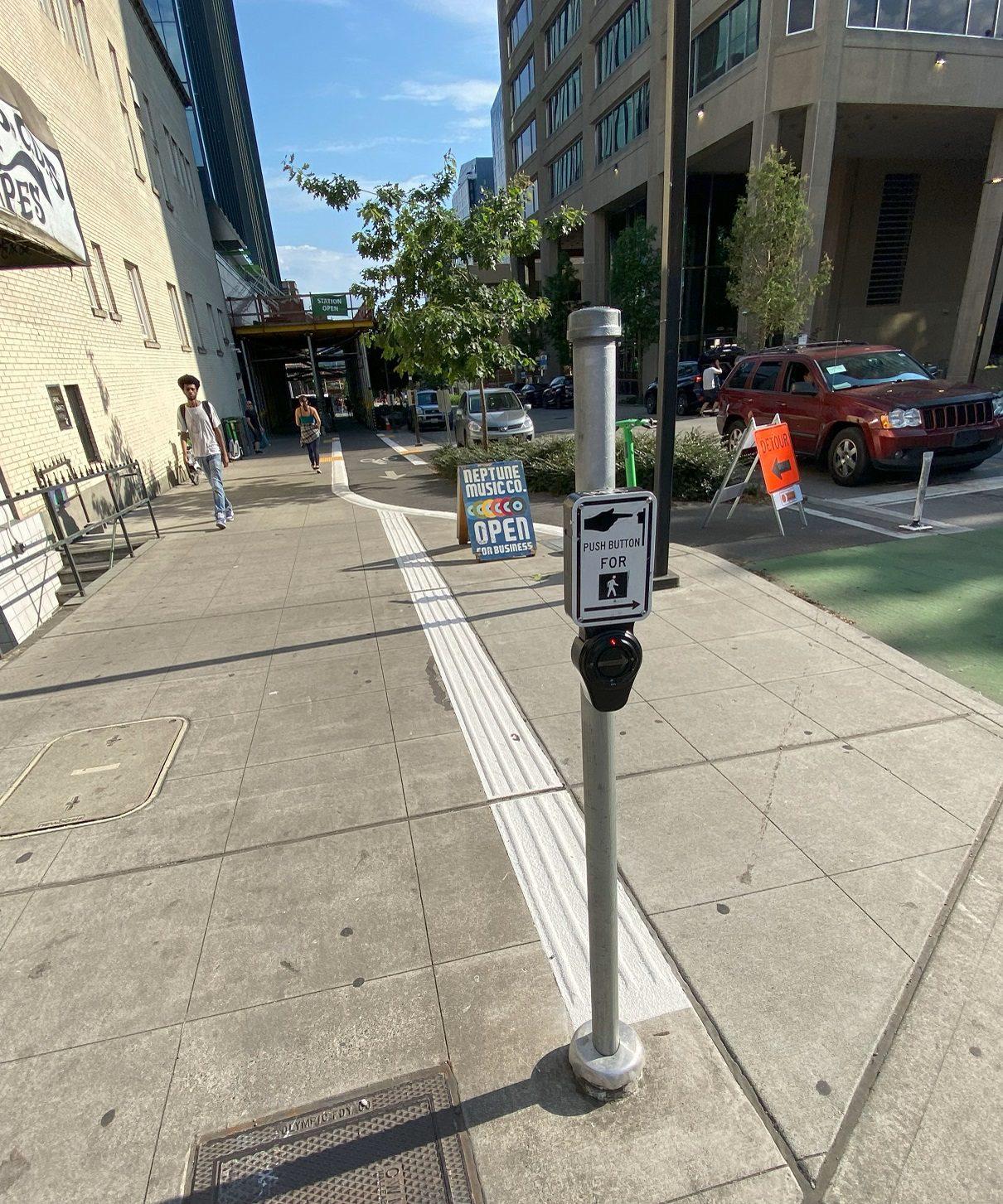
Four-bar treatment leading toward the accessible pedestrian signal. Photo: Seattle Department of Transportation. See Seattle DOT’s description of the pilot installation.
The city describes this as a pilot; the photograph shows the intended layout, not a measured result for users.
U.S. practice is still developing. TDIs appear in transportation research and selected projects, while applications and terminology vary among jurisdictions and internationally. Seattle DOT calls this treatment a “Tactile Directional Indicator.” The federal ADA truncated-dome provision is not a general mandate to install TDIs.
Before selecting a product, ask: What navigational question will this indicator answer at this exact location? The answer might involve following a route, finding a crossing signal, or establishing alignment. Those are different tasks and should be evaluated in their particular setting.
AccessField can help a project team evaluate the intended use, applicable guidance, existing environmental cues, available products, and field installation constraints. The details that make a tactile route coherent are specific to the site and deserve more attention than a standard product callout.
This article describes the intent of TDIs; it does not state that a TDI is required at a particular location or certify a proposed layout.